What Happens When Every Employee Has AI Agents?
I attended the OpenClaw Singapore meetup at Amazon's office. The tech is impressive, but the real question is what happens when every employee has AI agents.
Yesterday I was at Amazon’s Singapore office for the OpenClaw community meetup. Over 400 people showed up.
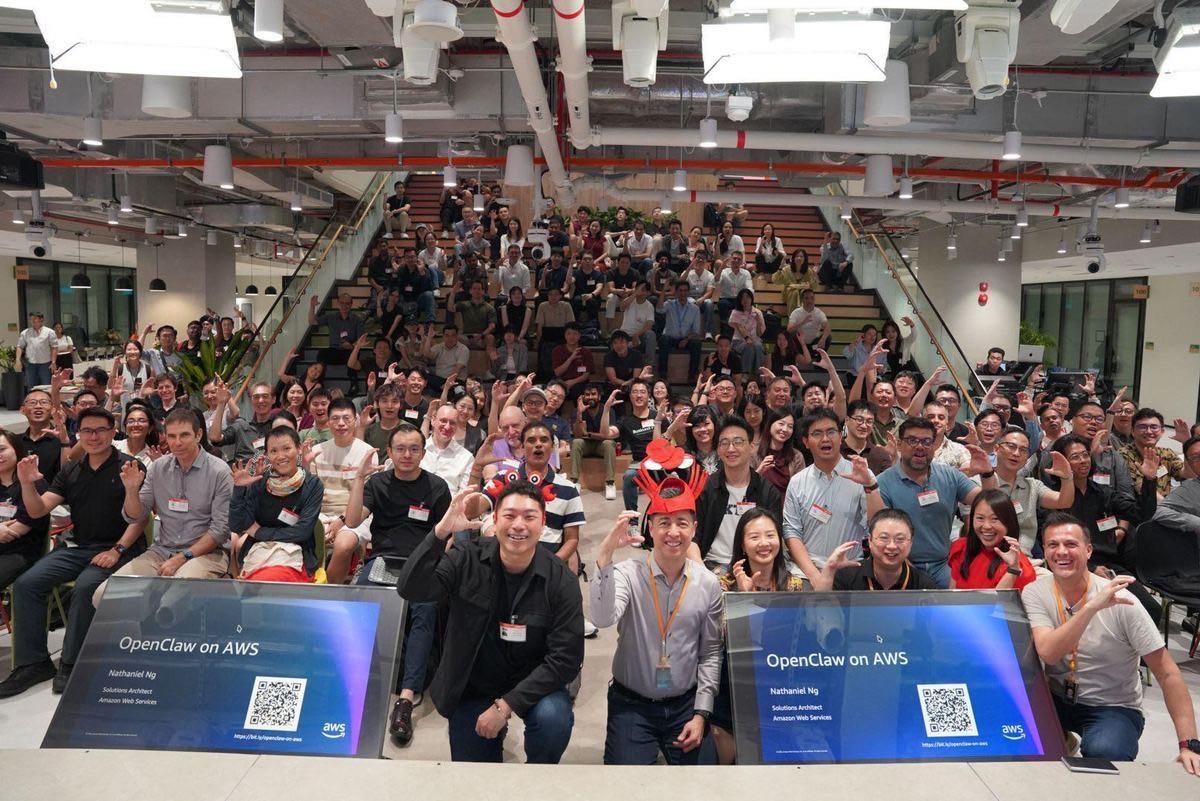
If you haven’t come across OpenClaw, it’s an open-source personal AI assistant built by Peter Steinberger. You run it on your own machine. It connects to WhatsApp, Telegram, Slack, Discord, basically any messaging channel you already use. And it DOES things. Clears your inbox, manages your calendar, runs shell commands, writes and executes code. It’s not a chatbot. It’s closer to having a full-time assistant who never sleeps.
The growth has been staggering. OpenClaw went from zero to 250,000+ GitHub stars in under four months. To put that in perspective, it surpassed the Linux kernel (which took 30+ years to reach 218K stars) and then overtook React to become the most-starred software project on GitHub. That kind of trajectory doesn’t happen with developer tools very often.
The energy in the room was exactly what you’d expect when 400 people realise they’re looking at something that fundamentally shifts how they work.
The open-source advantage (and its biggest risk)
OpenClaw grew fast precisely because it’s open source. Anyone can inspect the code, build skills on top of it, extend it in ways the original team never imagined. The community is moving at a speed that closed-source products simply cannot match.
But that same openness introduces real security concerns.
One of the sessions that stuck with me was about prompt injection risks. When you give an AI agent access to your email, your calendar, your file system, and your messaging apps, you’re handing it the keys to your digital life. A carefully crafted message from a stranger could, in theory, instruct your agent to do something you never intended. Forward sensitive emails. Modify files. Send messages on your behalf.
This isn’t hypothetical. It’s a known class of vulnerability, and the OpenClaw community is actively working on it. But the reality is, unless these security issues are properly addressed, OpenClaw will always be best suited for personal use. Which is fine. Steinberger himself has said OpenClaw is meant to be your personal assistant. That’s the vision, and it’s a good one.
But it does mean there’s a ceiling on where this specific tool can go inside organisations.
The real question isn’t about OpenClaw
What I keep coming back to is bigger than any single tool.
AI agents are GENUINELY powerful. I’ve seen people automate hours of daily work into minutes. I’ve watched agents coordinate across tools, make decisions, and execute multi-step workflows that would normally require a person switching between six different apps. I built a 9,700-page website using AI tools with no developers. As a non-technical founder, I’m now writing production code alongside my engineer. The leverage is real.
The productivity gain is not incremental. It’s multiplicative.
So here’s what I’m actually thinking about: if every individual can now have a team of personal AI agents handling their email, their scheduling, their research, their first drafts, their code reviews, what does that mean for how teams function?
When one person can do the work of three, what happens to team structures? When everyone has agents working in parallel, how do you coordinate? When your agent and my agent need to collaborate, what does that workflow even look like?
From personal assistants to organisational intelligence
Right now, the conversation is mostly about individual productivity. “Look what my AI agent can do.” And that’s exciting. But the harder, more interesting problem is the organisational one.
How do you go from “I have a personal assistant” to “our company operates with AI agents as core team members”?
That requires thinking about:
- Governance. Who approves what an agent can do? What are the boundaries?
- Security. How do you prevent one compromised agent from accessing everything?
- Coordination. How do agents across a team share context without duplicating work or creating conflicts?
- Accountability. When an agent makes a mistake, who owns it?
None of these are solved yet. And they won’t be solved by better models or faster inference. They’ll be solved by the people who figure out the frameworks, the processes, and the organisational design around these tools.
What I took away from that room
400+ people in Singapore, on a Monday evening, at Amazon’s office, talking about AI agents. The builder energy in this city is real.
The tech will keep improving. OpenClaw will get more secure. New tools will emerge. That part is inevitable.
The part that isn’t inevitable is how quickly organisations figure out how to actually use this. Not as a novelty. Not as a personal productivity hack. But as a fundamental rethinking of how work gets done.
That’s the question worth sitting with.